(SeaPRwire) – By: Arthur Pendelton
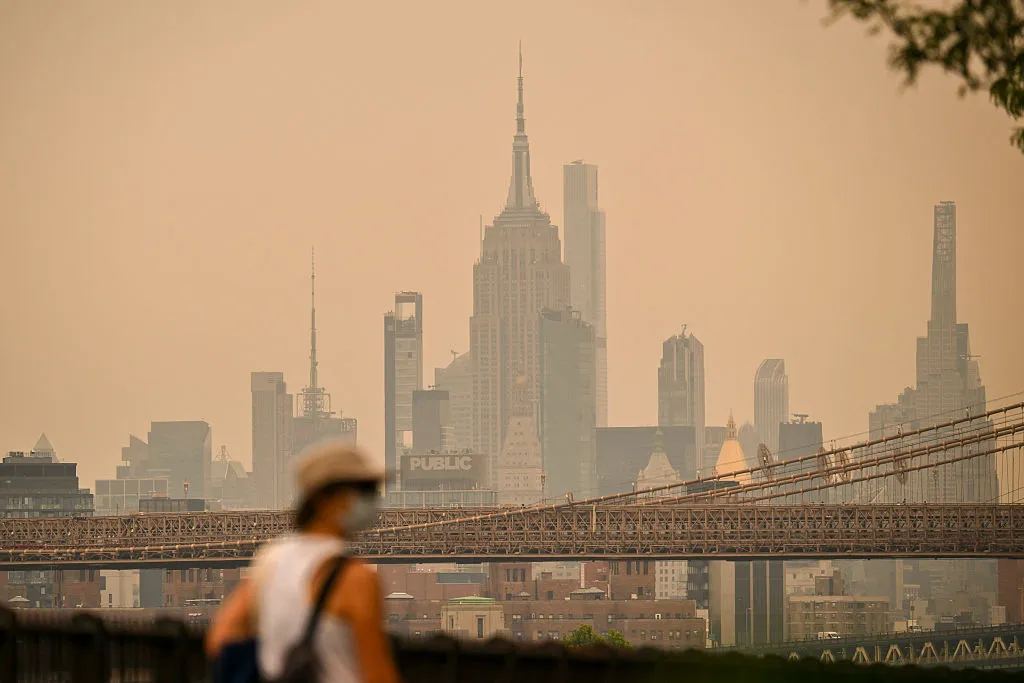
The recurring haze choking American cities isn’t a weather anomaly. It’s a protocol failure. The technical governance of our shared atmospheric commons has broken down, exposing a critical flaw in continental-scale environmental routing. When the Air Quality Index (AQI) in Detroit hits 500, it’s not just a health alert. It’s a packet storm of particulate matter, a denial-of-service attack on public lungs, routed directly from over 900 active Canadian wildfire nodes. The official forecast maps show northwesterly flows ushering smoke toward the northeastern quarter. This is the language of meteorology masking a deeper systemic collapse. We are witnessing the internet balkanization of the sky, where sovereign firefighting capacity deficits in one nation create hazardous conditions across an entire borderless airshed. The technical protocols for cross-border environmental hazard mitigation have no effective handshake. There is no BGP for smoke. No firewall for PM2.5. The result is a predictable, annualized degradation of a critical public resource, treated as an act of God rather than a governance engineering failure.
[Official Release Facts]: The smoke spread this week, leading to dangerous AQI levels forecast to continue into the weekend. On Thursday, Toledo, Milwaukee, and Detroit saw AQI levels over 500, far surpassing the hazardous threshold of 300. Health experts equated a day outside in AQI 150+ to smoking seven to nine cigarettes. Officials urged people to stay inside and wear N95 masks if venturing out. The National Weather Service confirmed northwesterly flow would continue to usher smoke into the U.S. Northeast this weekend. As of Friday afternoon, roughly 900 fires burned in Canada, with 122 classified as “out of control.” Detroit had the world’s worst air quality. Chicago and Washington, D.C., ranked fourth and fifth. New York placed fourteenth.
[Geopolitical Technology Blocs]: The raw data points to a fragmented response architecture. The AQI is a standardized metric, a universal protocol. Yet its alarming readings trigger only local, reactive advisories—stay inside, wear a mask. The source of the pollution, 122 “out of control” fires in a neighboring sovereign state, exists in a separate operational and fiscal jurisdiction. There is no seamless cross-border API for real-time firefighting resource allocation, no shared compute cluster for predictive containment modeling that automatically triggers continental asset deployment. The smoke plume is a geopolitical packet. Its path is dictated by physical wind protocols, but its origin and mitigation are trapped in siloed national “networks.” The U.S. monitors and warns. Canada fights with its own strained resources. The atmospheric data layer is global and interconnected. The response layer is parochial and under-provisioned. This is the core architectural flaw.
[Official Release Facts]: Forecasters predicted heat and smoke would subside in some areas starting Friday but worsen in others this weekend. In Toledo, the AQI on Friday remained over 300, expected to drop to 100-200 by Saturday—still unhealthy. Unhealthy levels in Toledo, Milwaukee, and Detroit were predicted to persist through the weekend into Monday. New York’s worst hit was Thursday (AQI near 200). Smoke cleared slightly Friday but was forecast to return, worsening pollution Saturday before clearing Sunday. Washington, D.C., had an AQI around 200 Friday, with poor quality continuing into Saturday before clearing Sunday and Monday.
[Geopolitical Real Intentions]: The forecast timeline reveals a governance model built on passive endurance, not active resolution. The public communication is a countdown to clearance: hold on until Sunday. The unstated assumption is that the external threat will abate on its own, through rain or wind shifts. There is no timeline for extinguishing the source, only for waiting out the transmission. This acceptance frames the crisis as a temporary atmospheric condition, like a thunderstorm, rather than a persistent failure of land management and climate adaptation whose externalities know no border. The rankings—Detroit worst in the world—are a grim leaderboard of exposure. They highlight which cities sit downstream of the broken protocol. The response is not to fix the protocol but to advise citizens to implement personal packet filtering: N95 masks. This is the equivalent of asking every internet user to run their own VPN and firewall because the core network is under sustained attack. It privatizes the cost of a public infrastructure failure.
The internet was built to route around damage. Our approach to transnational air pollution is to let the damage route through us. Until we establish binding technical governance bodies with the authority and resources to manage the atmospheric commons as critical, shared infrastructure—with enforceable protocols for prevention, suppression, and cost-sharing—these smoky weekends are not an interruption. They are the new, fragmented standard. The balkanization is complete when you check an air quality app more often than the weather forecast, and the only reliable solution is a personal respirator.
Author bio: Arthur Pendelton, an expert on global internet routing architecture and technical governance boards, specializing in the policy frameworks of transnational infrastructure systems.